

Artículos sobre cómo grabar y editar vídeos como profesionales
The Paradox of AI Cloning
The ability to clone a person's voice and image using just a photo or video opens a new paradigm for journalism, where a reporter can be everywhere at once... But it brings with it a brutal paradox: it is capable of both putting a journalist out of work and allowing them to build their own media outlet.
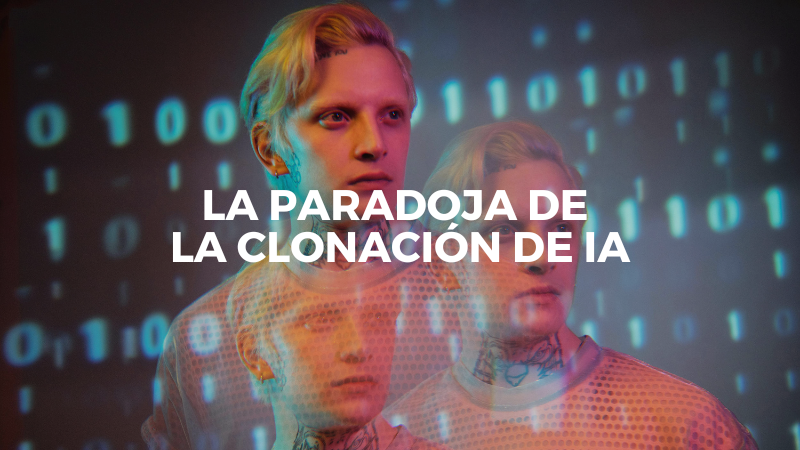

I recently attended a practical lead generation workshop hosted by a digital marketing agency. On paper, it was nothing new: the training focused on creating a sales funnel to attract clients by appealing to the pain points of your ideal customer (the buyer persona, in marketing terms). Just another one... or so it seemed.
Because the workshop presented a revolutionary way to capture them: through ads consisting of photos created by Artificial Intelligence... and videos featuring your own image and voice, also cloned with AI.
I already knew that AI image cloning existed (thanks, Instagram reels). It basically involves uploading a photo or video of yourself to an online platform and—for very little money or even for free—the site creates a moving avatar of you with a voice similar to your own. Because it clones the voice, too.
The speaker explained that using video clones allowed him to focus on priorities and delegate a tedious task, like recording a video, to AI. It makes sense: instead of blocking out hours of your day thinking about what to say, setting up the lighting, and doing take after take until the message is perfect... you delegate that to AI and move on to more important things.
For my part, I began to think about what the application of these types of cloning tools could mean for journalism, and I reached the following conclusions.
For a media outlet, once the inevitable phases of avatar creation and production workflow adjustments are over, it could represent a genuine revolution in storytelling, because it allows them to cover more stories in more places with fewer staff. Let me explain.
Imagine a local TV station covering a region of six municipalities with a staff of only two journalists and an editor. If news breaks simultaneously in all six locations, those two journalists are going to have an interesting day racing from one point to another.
But if they have the chance to clone themselves on video, they only need to attend two of the scenes... and the other four can be perfectly covered by their avatars. Less effort, less expense (especially on gas), and more efficient results.
So efficient, in fact, that to a greedy owner, those two journalists might represent a redundant expense. Since they have an editor and tools that generate human-like avatars, those journalists are no longer necessary and find themselves out on the street.
In this case, the AI has served to optimize the profit of a news industry at the expense of journalistic credibility. From that point on, the outlet's news will be delivered by two AI avatars. Let’s hope the editor at least does their job and writes good copy for the AI to read.
And now it's the journalists' turn. Sticking with this example, we have two people in the unemployment line. One quickly finds work in a PR office. The other doesn't.
But they have learned to clone themselves with AI and decide to start their own news project based on their experience and contacts: another local TV station consisting only of themselves... and their avatars. Acting as the editor, they receive information from press releases, visit the locations that interest them, and equipped with a smartphone and AI tools, they soon have a news business that covers the same ground as their former employer... and is even more profitable.
In this other case, AI has served to generate not only a job but also a new business and a new one-person, self-sufficient media outlet.
And this, in my opinion, is the paradox of AI cloning for journalism: it has the capacity to optimize a news company while simultaneously destroying jobs... but also the capacity to create new media outlets, companies, and jobs that are extremely effective, atomizing the market until only the strongest remain.
And all of them, as José María García would say, gifted with the power of ubiquity: capable of being everywhere at once, just like in the famous movie.
It won't be long before we see it.
Soy Alex Guillén, periodista experto en vídeo. Enseño a periodistas a grabar y editar nivel PRO con el móvil para que sean más rápidos, hagan vídeos de más calidad y ganen confianza.
Si quieres apoyar este contenido te invito a que te suscribas no solo a mi newsletter sino también a mi suscripción PRO. Por solo 5 euros al mes o 25 euros al año además de demostrarme eso de “Yo te apoyo, Raquel Bollo” te llevas GRATIS mi guía ‘Cómo crear contenido audiovisual fácil y gratis’. En ella te enseño a grabar en modo pro con smartphone, editar fácil y gratis en Edits y Crear contenido masivo gratuito en vídeo.

Comments
No comments yet. Be the first to comment!